

 Language
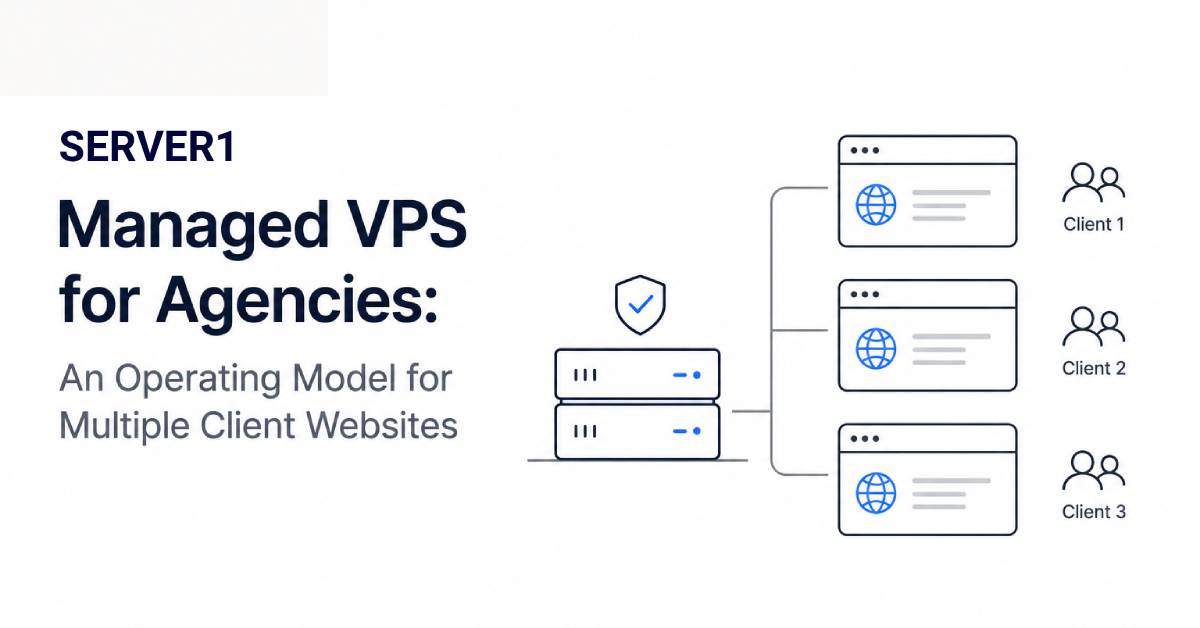
Hosting five client websites is usually simple. At twenty clients, hosting becomes its own operational product: where each site lives, who has access, which client consumes memory, how backups are handled and what happens when a customer leaves.
Managed VPS does not solve those questions automatically, but it provides a solid foundation when the agency builds a disciplined operating model on top of it.
If the agency does not need root-level customisation, compare Reseller Hosting first; it is designed specifically around multiple clients, white-label accounts and centralised Plesk management.
A three-layer operating model
| Layer | What it covers | Main goal |
|---|---|---|
| Infrastructure | OS, web stack, monitoring and backups | A stable shared platform |
| Client isolation | Users, subscriptions, databases and permissions | One client should not expose another |
| Agency workflow | Updates, access, SLA and offboarding | The process should not depend on one person |
If the reseller model is new to you, our guide to what reseller hosting is helps separate shared, reseller and VPS responsibilities.
Clients are not equal - I would group them into three tiers
Tier A - small brochure or corporate websites
Moderate traffic, standard WordPress and relatively low business criticality. These sites often fit comfortably on a well-isolated shared VPS environment.
Tier B - active stores and business systems
Resource monitoring, more deliberate backup frequency, update windows and incident priority become more important. One client's peak should not degrade everyone else.
Tier C - high-risk or unusual requirements
Heavy traffic, specific security/compliance needs or a revenue-critical application often deserves a separate VPS. “It technically fits” is not always a good operational argument.
Agency time is a direct operating cost, so the trade-offs in our article on server management and time savings are worth considering when deciding what stays in-house and what moves to a managed service.
A maintenance calendar reduces chaos
- Daily: review alerts and critical service health;
- Weekly: review updates and abnormal resource use;
- Monthly: review access, storage growth and perform a backup restore spot-check;
- Before major changes: prepare backup, staging and rollback.
Parts of this can be automated, but automation needs failure detection as well.
Access: “everyone gets root” does not scale
Give developers access to the projects they work on, give clients only what they need, and keep system-level privileges with a small set of people. Plesk subscriptions can help create those boundaries; for more context see our Plesk infrastructure overview.
Document offboarding before you need it
- Create a complete customer backup/export;
- transfer credentials through an agreed method;
- define the DNS/migration support boundary;
- remove agency keys and users;
- delete retained data after the agreed retention period.
If that procedure exists only in one employee's head, it becomes a scaling risk.
When I would move a client to a separate VPS
When its traffic or security profile differs sharply from the rest; when its resource spikes affect other clients; or when the business cost of an outage no longer justifies a shared failure domain.
A managed VPS becomes most valuable to an agency when it removes system-level operational work and lets the agency focus on client applications. Good results still come from discipline: isolation, ownership, maintenance and documented offboarding.