

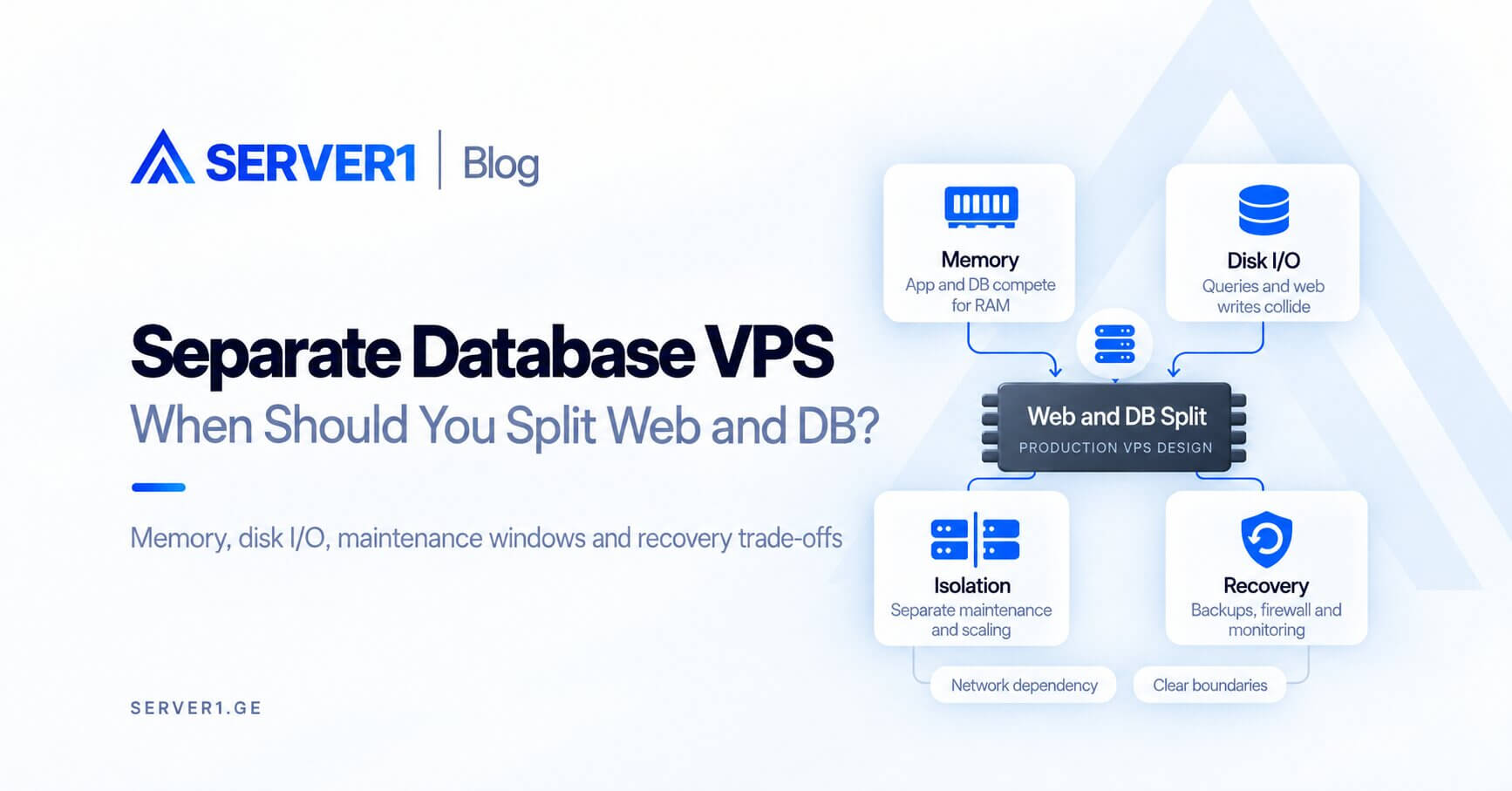
Moving a production database to its own VPS makes sense when the web/application and database workloads are competing for memory, disk I/O or maintenance windows. Two servers are not automatically a better architecture for a small project - they also introduce network dependency, firewall rules, monitoring and more complex recovery.
Answer three questions first
- Is the database actually the bottleneck? Splitting hosts will not repair an application problem.
- Are resources competing? A database cache may need memory that PHP or Node workers are consuming on the same VM.
- Do the layers need independent scaling? Separation becomes useful when web and DB capacity grow at different rates.
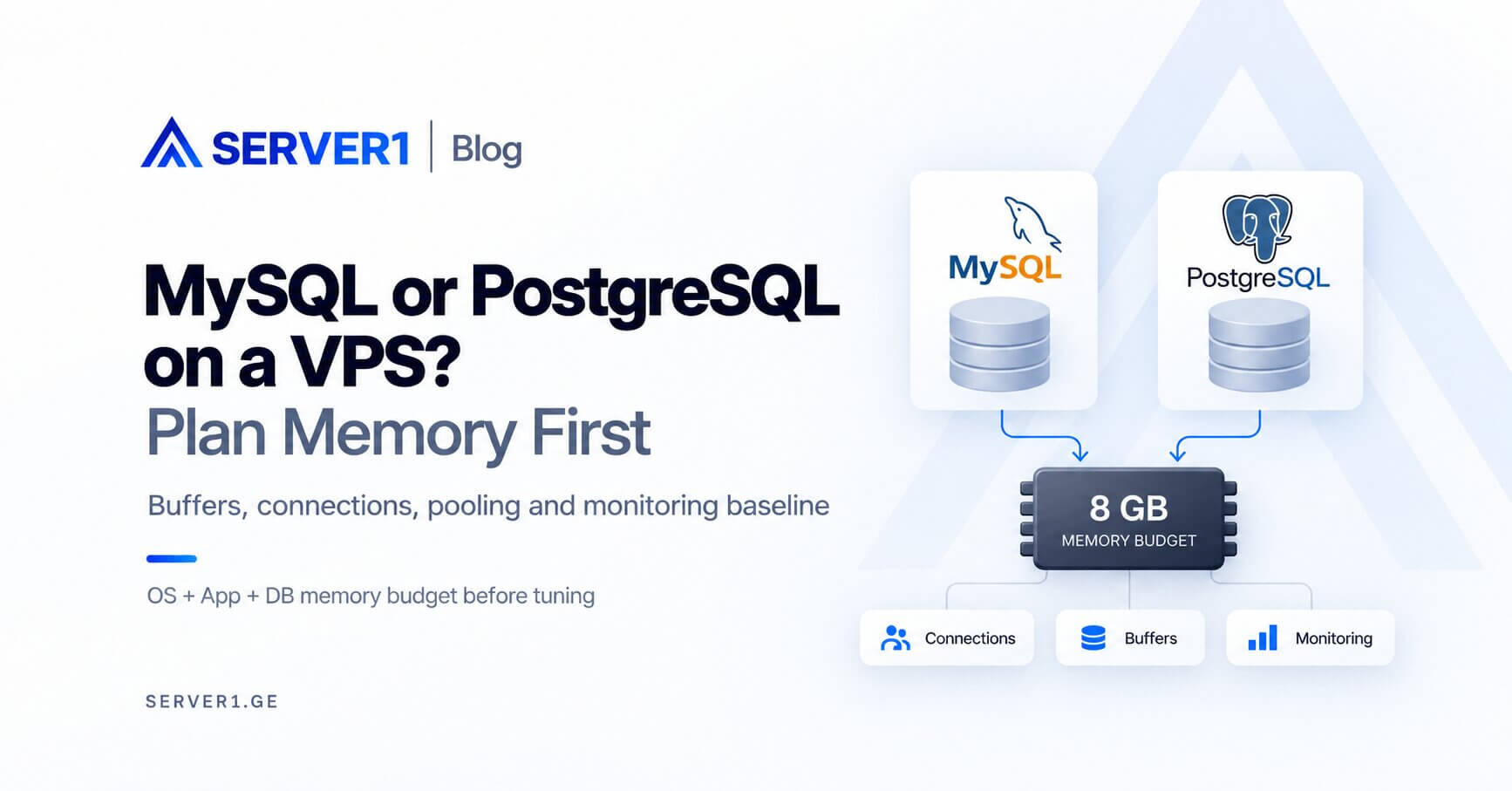
Start with our MySQL/PostgreSQL memory-planning guide so the database is sized from observed workload rather than guesswork. the database server sizing guide adds broader capacity context.
What you gain - and what you add
| Benefit | New responsibility |
|---|---|
| dedicated DB memory/I/O budget | network latency and private routing |
| independent resizing | maintenance for another OS |
| clearer monitoring | cross-host backup and recovery |
| web restarts do not restart DB | firewall and authentication design |
A public database port should not be the default
Prefer private connectivity or source-restricted firewall rules between the application and DB VPS. The fact that another VM needs database access is not a reason to expose the port to the whole Internet.
Migration playbook
- capture current latency, connection count, DB size and backup duration;
- prepare the new DB VPS and private connectivity;
- restore a copy and run application tests;
- verify migrations, workers and long-running queries;
- plan cutover and rollback;
- compare p95 latency and resource usage with the original baseline.
If outage cost matters, the downtime impact guide helps frame the maintenance window. Compare SERVER1 VPS for infrastructure choices, or Managed VPS if OS-level operations across both hosts should be delegated.
Separate the database when it solves a measured resource or ownership problem - not because two servers merely look more “enterprise”.