

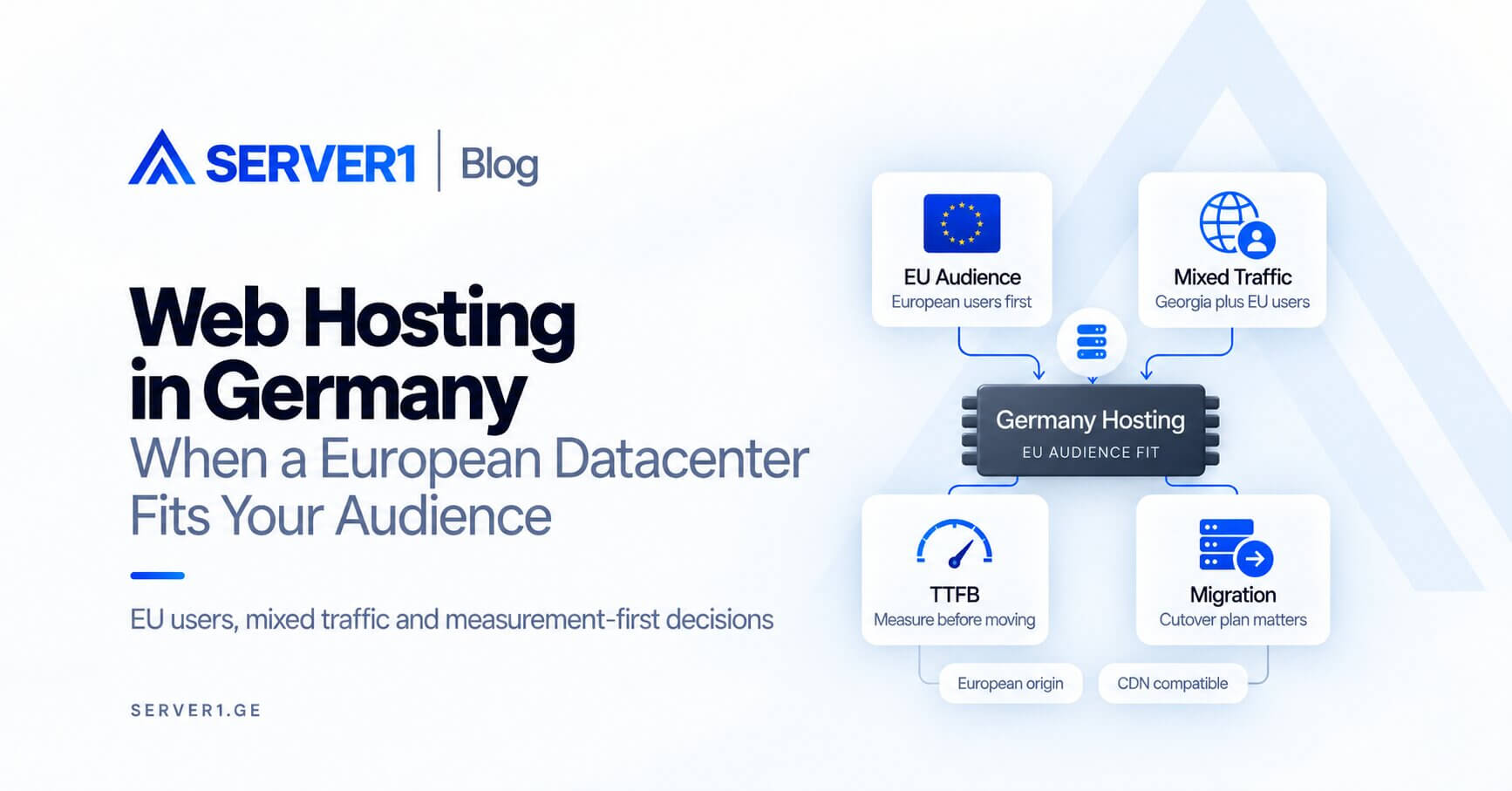
A German datacenter is a practical option for businesses with European users or a mixed Georgia/EU audience. The final decision should still be measurement-driven: “Germany is in Europe” is not enough as a technical argument.
Three scenarios
1. Georgian business with European customers
Germany is often a useful location to test because it provides a European origin while remaining practical for users in Georgia, depending on routing.
2. EU-focused website
A European origin is logical, especially for dynamic pages and APIs. A CDN can further distribute cacheable assets.
3. Audience almost entirely in Georgia
Compare Germany with local hosting rather than assuming an international location is better.
Review Web Hosting in Germany and compare it with Web Hosting in Georgia.
What to measure before migration
| Metric | What it reveals |
|---|---|
| TTFB from target regions | origin latency plus application time |
| connect time | network-path behavior |
| dynamic-page latency | more realistic location impact |
| admin/upload responsiveness | day-to-day team experience |
our bandwidth and hosting guide explains why port speed and application throughput are different.
Migration needs a cutover plan
Files, databases, DNS TTL, mailboxes, SSL, redirects and forms should be tested together. Validate the new environment before DNS changes. If you want the transfer handled for you, review Hosting Migration.
SEO and user experience
Faster response is useful, but moving countries does not guarantee rankings. See our hosting and SEO guide for the wider relationship.
Choose Germany when a European origin matches the audience, latency and operating requirements - not simply because of the country's reputation.