

 Language
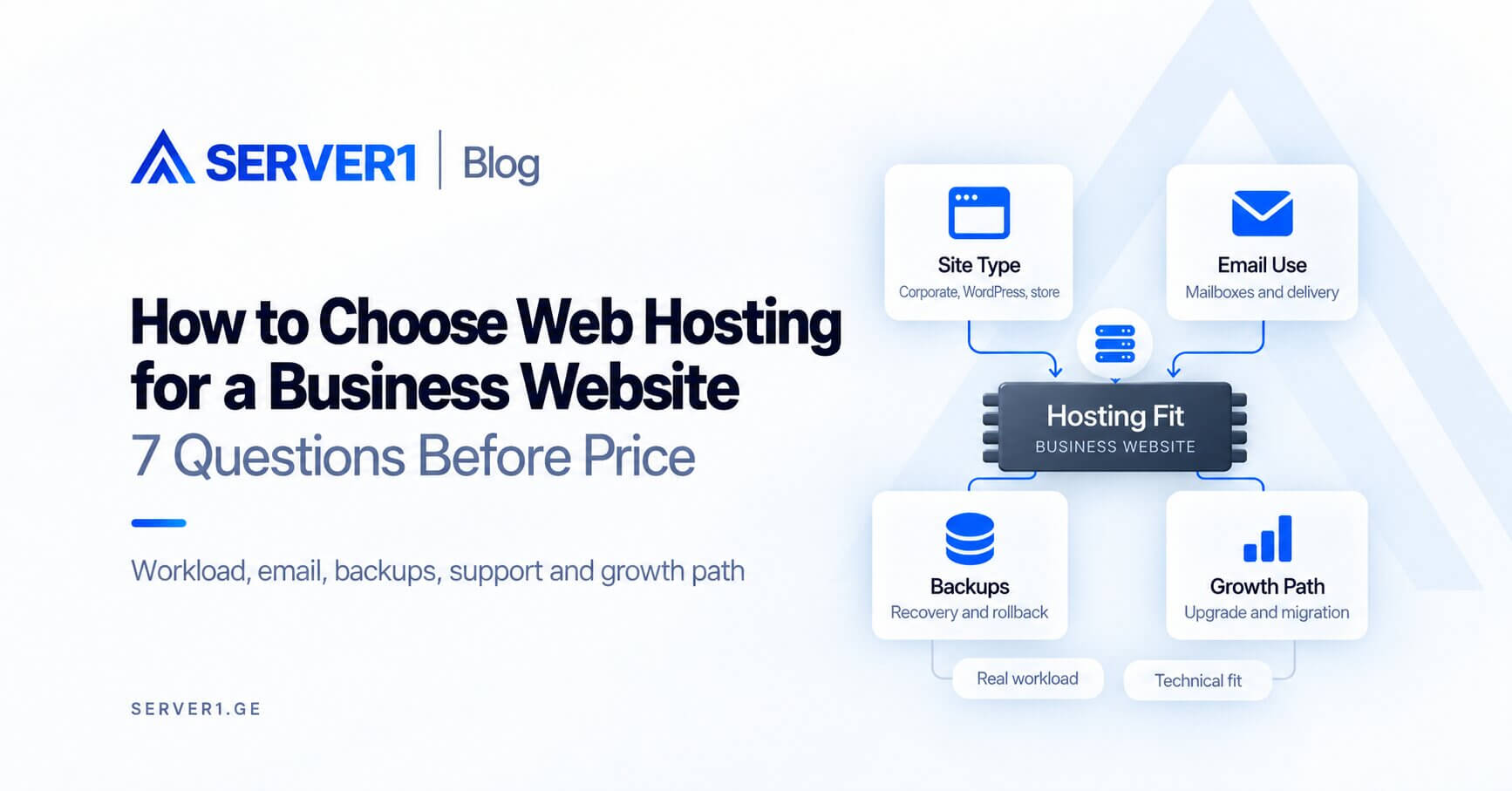
Choosing hosting for a business website is not just a comparison of disk space and monthly price. The right plan must fit the site's actual workload, email use, backup requirements, the team's technical skills and a realistic growth path. If those questions are ignored, a cheap plan can become expensive through downtime or rushed migration.
Seven questions to answer before comparing price
- What type of site is it? Corporate site, catalogue, WordPress, WooCommerce or custom PHP?
- How dynamic is the workload? Ten thousand cached pageviews and ten thousand uncached checkout requests are not equivalent.
- How much email do you need? Mailboxes can consume meaningful storage.
- What does backup actually include? Check frequency, retention and restore process.
- Where are users located? Datacenter location affects latency and routing.
- Who owns operations? Shared hosting is attractive when root administration is unnecessary.
- What happens when the site grows? Upgrade path matters as much as today's price.
Start with our web-hosting fundamentals guide and the hosting-plan selection guide. For the product path, review SERVER1 Web Hosting.
Ask about limits, not just “unlimited” labels
CPU, memory, PHP processes, database connections and mail limits can matter more than headline disk capacity. The important question is how the environment behaves during peaks and how clearly the provider explains fair use.
Backup is not the same thing as recovery
Daily backups are useful, but a business also needs to know which restore points exist and how restoration is requested. our guide to common web-hosting problems provides useful operational context.
Choose datacenter location from the business geography
| Audience | Location to test first | Reason |
|---|---|---|
| Mainly Georgia | Georgia | short local network paths |
| Georgia + Europe | Germany | practical central-European connectivity |
| Northern Europe / diversification | Finland | another European location option |
Location is only one performance layer. CDN, caching, PHP/database time and frontend optimization can dominate, so finish the decision with measurements rather than geography alone.
When shared hosting is no longer the right class
If the application needs root access, Docker, custom daemons, heavy background processing or repeatedly reaches shared resource limits, VPS may be the next step. For a normal business site, however, VPS can add unnecessary operational work.
The best web-hosting plan is not the cheapest one; it is the simplest plan that meets today's workload without blocking tomorrow's growth.