

 Language

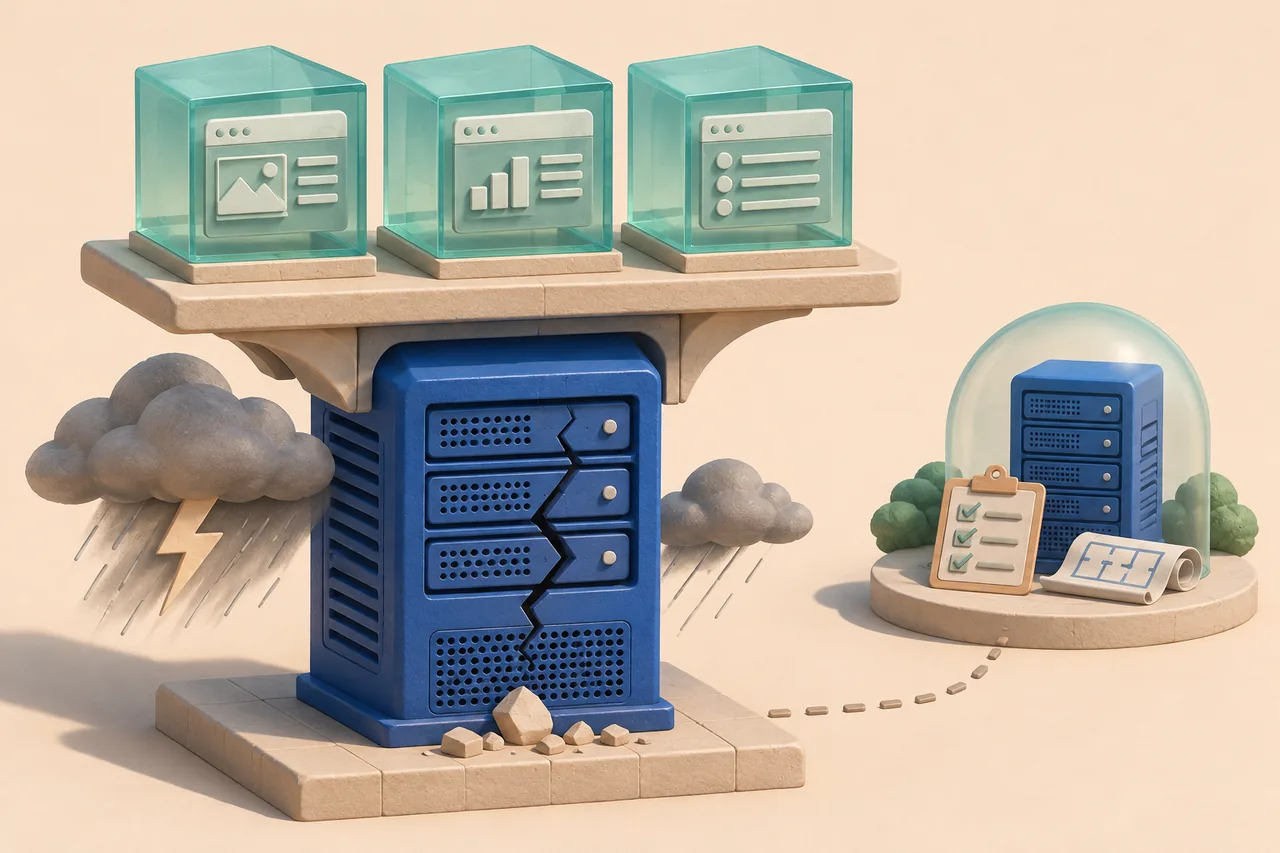
A powerful dedicated server can process more work, but capacity alone does not keep a service available. If the application, database and only recovery copy all depend on one machine, losing that machine may remove all three. Before ordering, separate two questions: how much work the system can handle, and how it will return if the entire machine becomes unavailable.
The following scenarios are planning examples, not reports of SERVER1 incidents. Their purpose is to expose dependencies without switching off a working production server. Begin with a tabletop discussion, the people responsible and the documentation you already have. Unknown answers become tasks rather than assumptions about protection.
Scenario one: the server stops responding
Visitors cannot open the website. The team first distinguishes an application problem from a network or machine problem. Who receives the alert, who can contact support, and what evidence should they provide? “The site is down” is rarely enough. The start time, affected services and safely collected symptoms make the conversation more useful.
Now assume the existing machine cannot return quickly. Is there a path to another environment? Does someone know the required operating system, runtime, configuration and access process? Buying a dedicated server does not automatically reserve a replacement machine or establish a replacement deadline. Confirm those conditions in the actual offer rather than inferring them from the word dedicated.
Scenario two: a backup exists but cannot be used
A file called backup does not prove that the copy is complete or that the responsible person can restore it. The database, encryption key or required application version may be missing. If the key lives only on the failed server, an independently stored archive may still be unusable. Recovery needs the dependencies as well as the data.
Record the copy's time, location, retention and access ownership. Rehearse recovery in an isolated environment with real email, payment and provisioning integrations disabled. Agree the exercise with the responsible team. The FBI's cyber resilience guidance also stresses isolated backups and tested restoration. That recommendation does not establish what any particular hosting package includes.
Scenario three: the application returns, but visitors go elsewhere
The technical restore may succeed while domain control belongs to another person or account. If the authorised DNS administrator is unavailable, switching to the replacement environment stalls. Document ownership of the domain, DNS, certificates and external integrations in advance. This means naming responsibilities and a secure access process, not collecting everyone's passwords in one document.
An external service may allow only the old IP address, a callback may point at the previous environment, or a licence may depend on the original machine. Include these dependencies in the recovery plan. A 200 response from the replacement web server verifies only one layer. Authentication, data correctness and important business operations require separate, safely designed checks.
Agree two objectives before choosing the solution
- How much interruption can the business tolerate?
- A recovery time objective states when the required service should return. It is a planning target unless a specific agreement establishes a commitment.
- How much recent data can the business lose?
- A recovery point objective describes the acceptable gap between the last usable recovery point and the interruption. A daily copy is not sufficient for every workload.
These answers affect copy frequency, the need for another environment, recovery ownership and cost. Before selecting the most expensive configuration, identify which failure the additional expense addresses. Two machines can still share a weak dependency. Conversely, a modest workload may need a clear, tested restoration plan more urgently than a complicated cluster nobody can operate.
Use the dedicated capacity planning checklist for sizing, and our uptime and downtime explanation for terminology. When considering managed dedicated service, agree management, backup and recovery responsibilities in writing. A capable machine and a usable recovery plan solve different parts of the same business need.